dido:public:ra:1.2_views:3_taxonomic:1_topologies:3_distributed
Differences
This shows you the differences between two versions of the page.
| Both sides previous revision Previous revision Next revision | Previous revision | ||
|
dido:public:ra:1.2_views:3_taxonomic:1_topologies:3_distributed [2019/06/28 09:06] nick |
dido:public:ra:1.2_views:3_taxonomic:1_topologies:3_distributed [2021/10/05 18:32] (current) nick ↷ Links adapted because of a move operation |
||
|---|---|---|---|
| Line 1: | Line 1: | ||
| - | ======= C. Distributed Network Topology ======= | + | ====== 2.3.1.3 Distributed Network Topology ====== |
| - | [[dido:public:ra:1_views| Return to the DIDO Architecture page]] | + | [[dido:public:ra:1.2_views:3_taxonomic:1_topologies:start|return to Network Topology Taxonomy]] |
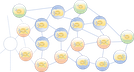
| - | In the Distributed network topology, all nodes are equal peers within the system, with each acting as a redundant copy of other nodes. This provides for extremely high fault tolerance, tied to the number of nodes. The more nodes, the greater the tolerance to faults. Since each node is an equal peer, there is no single point of failure and there is no one master copy of the data. As a result, the Distributed system becomes almost infinitely scalable. | + | In the distributed [[dido:public:ra:xapend:xapend.a_glossary:n:nettopo|network topology]], all [[dido:public:ra:xapend:xapend.a_glossary:n:node|nodes]] are equal peers within the system, with each acting as a redundant copy of other nodes. This provides for extremely high [[dido:public:ra:xapend:xapend.a_glossary:f:faulttolerance|fault tolerance]], tied to the number of nodes. The more nodes, the greater the tolerance to faults. Since each node is an equal peer, there is no single point of failure and there is no one master copy of the data. As a result, the [[dido:public:ra:xapend:xapend.a_glossary:d:distsystem|distributed system]] becomes almost infinitely scalable. |
| <figure> | <figure> | ||
| - | {{ :dido:public:ra:distributed_network.png?100 |}} | + | {{ dido:public:ra.1.intro:distributed_network.png?100 |}} |
| <caption>Distributed Network Topology | <caption>Distributed Network Topology | ||
| </caption> | </caption> | ||
| </figure> | </figure> | ||
| - | However, all nodes are not really considered “equal” in the truest sense. Some nodes are used simply to create a simple transaction, others record all the information within the blockchain, and others go on to validate transactions by mining. | + | However, all nodes are not really considered “equal” in the truest sense. Some nodes are used simply to create a simple transaction, others record all the information within the [[dido:public:ra:xapend:xapend.a_glossary:b:blockchain|blockchain]], and others go on to validate transactions by [[dido:public:ra:xapend:xapend.a_glossary:m:mining|mining]]. |
| <figure> | <figure> | ||
| - | {{ :dido:public:ra:marketcapcryptocurrencies.png?500 |}} | + | {{ dido:public:ra.1.intro:marketcapcryptocurrencies.png?500 |}} |
| <caption>Market Cap of Cryptocurrencies ($ Billions) | <caption>Market Cap of Cryptocurrencies ($ Billions) | ||
| </caption> | </caption> | ||
| </figure> | </figure> | ||
| + | /**=-=-=-=-=-=-=-=-=-=-=-=-=-=-=-=-=-=-=-=-=-=-=-=-=-=-=-=-=-=-=-=-=-=-=-=-=-=-=-=-=-=-=-=-=- | ||
| + | /* To add a discussion page to this page, comment out the line that says | ||
| + | ~~DISCUSSION:off~~ | ||
| + | */ | ||
| + | ~~DISCUSSION:on|Outstanding Issues~~ | ||
| + | ~~DISCUSSION:off~~ | ||
dido/public/ra/1.2_views/3_taxonomic/1_topologies/3_distributed.1561727214.txt.gz · Last modified: 2019/06/28 09:06 by nick
